
Sultan-Epe
Султан-Эпе
A sacred underground mosque with a working spring well inside the complex.
Quick facts
Best season
Spring, Autumn
Visit time
Half day
Experienced driver
Required
Family friendly
Yes
About this location
The man
Sultan-Epe was a Sufi mystic and the son of Hakim-Ata — himself a poet and direct disciple of Khoja Ahmed Yassawi of Turkestan. Where other Mangystau saints became patrons of shepherds or healers of the sick, Sultan-Epe carved out a unique role: he is the patron saint of sailors, fishermen, and all those in peril at sea — the only figure in Mangystau's sacred geography defined by his relationship with water. He spent his life on the shores of the Caspian, rescuing those who drowned and helping those lost at sea. To this day, the phrase "Sultan-Epe, save and protect" is uttered by Kazakhs before any sea voyage — it has passed into everyday speech the way a religious invocation becomes idiom.
One legend explains the origin of his mission: Sultan-Epe was late arriving to his dying father's deathbed — delayed because he stopped to rescue sailors drowning in the Caspian. His father, not knowing why, was angered by the delay and cursed his youngest son. But when he learned the reason, he gave Sultan-Epe his blessing — and with it, the power to protect all who travel by water forever after. Another legend credits him with raising slaughtered bulls back to life and walking across the surface of the Caspian Sea.
The date of his life is debated. Researchers place him anywhere between the 9th and 15th centuries; the mosque itself is dated by archaeologists to the 13th–15th centuries.
The canyon
Sultan-Epe mosque is inseparable from the canyon of the same name — one of the only coastal canyons in Mangystau, cutting through the steppe plateau just 4.5 km from the shore of the Mangyshlak Bay of the Caspian Sea. The canyon runs 2.6 km in its eastern section, narrowing to 330 metres at its western end. It is a genuine green oasis: the slopes are covered in hawthorn, mulberry, willow, and jida (oleaster), and a freshwater spring murmurs at the base — feeding meadows of nettles and burdock amid the surrounding desert. This combination of water, shade, and shelter has drawn people here since the Stone Age. In the 8th–9th centuries a military fortress occupied the canyon rim to guard access to the spring. In the 11th century, as Islam spread across Mangystau, Sufi communities moved into the caves.
The underground mosque
The mosque is carved into limestone on the western edge of the canyon cliff, at 158 metres above sea level. Archaeologists who excavated the site in 2003 found it unusual in plan — almost circular rather than the rectangular or cross-shaped chambers typical of other Mangystau mosques. This has led some researchers to suggest the structure may have served an astronomical or astrological function alongside its religious role. Two low circular skylights cut through the ceiling bring natural light into the interior. A well of water considered sacred and healing stands nearby. Pilgrims visit to ask for protection on long journeys and for recovery from illness. A large oval stone enclosure a short walk from the mosque marks what tradition identifies as the grave of Sultan-Epe himself.
The necropolis — Kenty-Baba
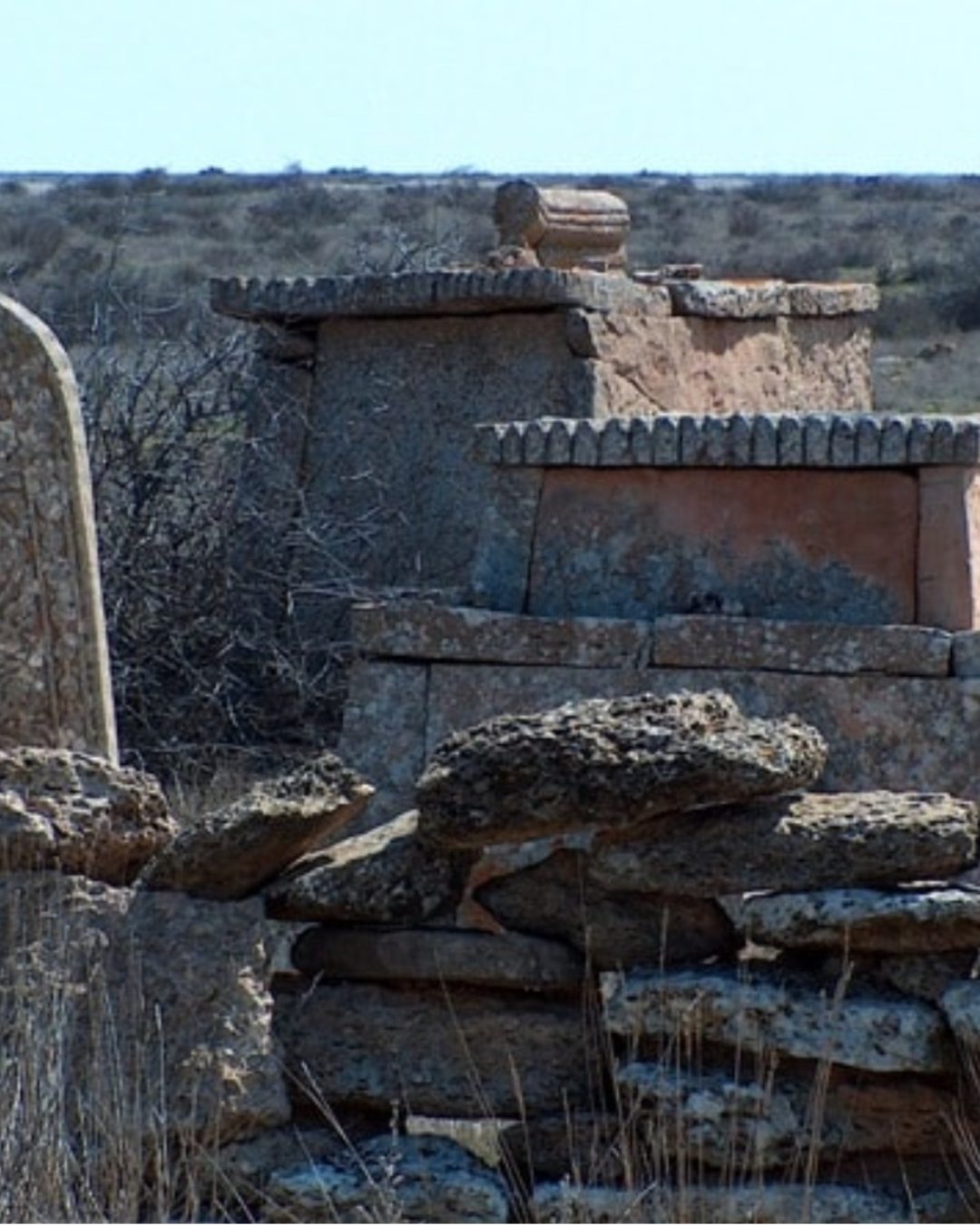
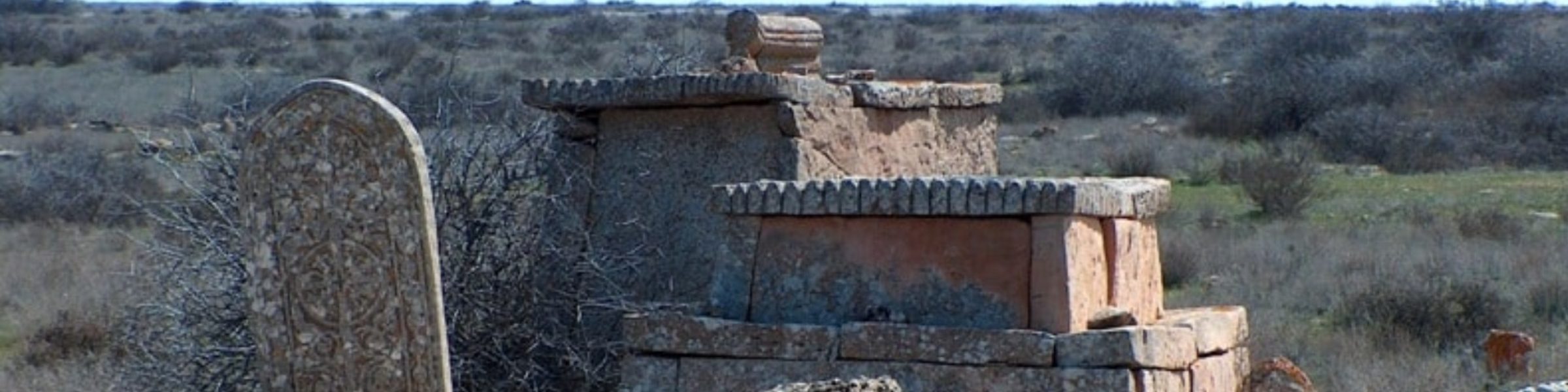
About 2 km from the mosque lies the necropolis of Kenty-Baba, one of the richest burial complexes in the region. It spans the 15th–20th centuries and contains a restored tower-type mausoleum, open to the sky, with a pile of arkhar (mountain sheep) horns left by hunters seeking blessing, and a fire stone blackened by centuries of burned sheep fat — the same Zoroastrian-rooted ritual found at Shakpak-Ata. A second roofless mausoleum has flat stone walls etched with horses, camels, swords, hands, rifles, and — notably — a cross. Headstones include sandyktas carved with weapons, kulpytases, and koy-tases. Stone Age sites have been found in the immediate vicinity.
Location
57–60 km east of Fort Shevchenko, in the Tupkaragan district. The site pairs naturally with Shakpak-Ata, Zhygylgan, and Kapamsay Canyon in the northern Mangystau circuit.
Mosque Visiting Etiquette
Men should wear long trousers, no shorts or sleeveless shirts. Women should cover their hair, shoulders, arms, and legs. Keep quiet and remove shoes before entering. Sadaqah is a customary voluntary donation with no fixed amount.
UNESCO status
UNESCO
Inscribed on the UNESCO World Heritage List on 25 July 2026 as part of the “Rock Mosques and Associated Sacred Sites of Mangystau” (World Heritage Site No. 1760, component 1760-005), alongside four other sacred complexes of the region.
Map points
Sultan-Epe
Султан-Эпе
44.47, 51.01
Safety and access warning
Remote routes may become difficult or unavailable after rain. Final access should be confirmed by the selected local provider before departure.
Provider check
Weather, road conditions and vehicle class should be checked before confirming the route.